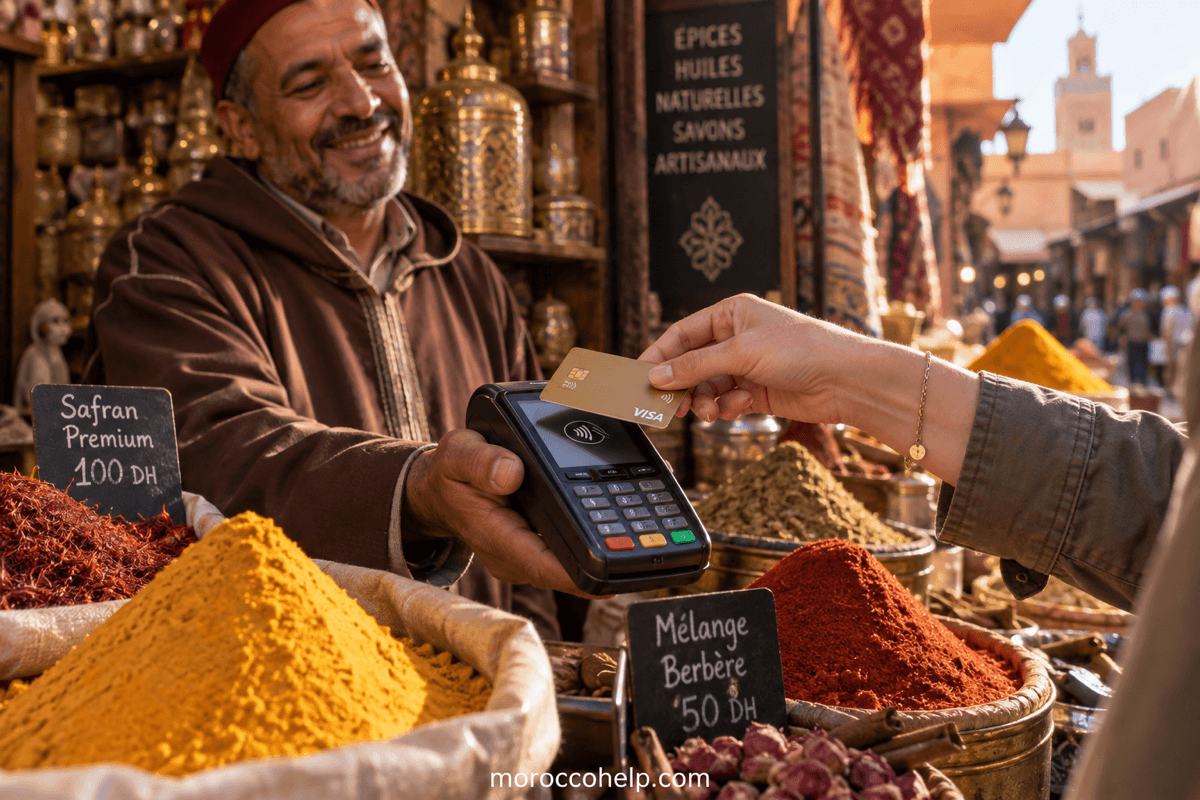
A small technical fee is about to make big news. From Thursday October 1, 2026, the general cap on domestic card payment interchange fees drops from 0.65% to 0.50% excluding tax, under the regulatory decision adopted by Bank Al-Maghrib in July 2026. Digital payments for public services get an even sharper edge: a special rate of 0.15%. For merchants, banks and consumers, this is one of the most consequential payment reforms of the decade in Morocco.
The reform in four numbers
Bank Al-Maghrib regulatory decision, effective October 1, 2026
What exactly changes on October 1, 2026?
| Type of card payment | Current cap | From Oct 1, 2026 |
|---|---|---|
| General domestic payments | 0.65% excl. tax | 0.50% excl. tax |
| Digital public services | – | 0.15% |
The interchange fee is the amount the merchant's bank pays to the cardholder's bank for each transaction. It is a core component of the cost a merchant ultimately pays to accept card payments. By cutting the general cap by almost a quarter (from 0.65% to 0.50%), Bank Al-Maghrib directly lowers the cost of accepting cards across the national payment system – and with the 0.15% rate, paying taxes, fines, fees and utility bills online becomes dramatically cheaper to process.
What are interchange fees, in plain language?
When you pay 100 dirhams by card at a shop, the money does not travel in one straight line. The merchant's bank (the acquirer) and your bank (the issuer) exchange several flows, one of which is the interchange fee – compensation for the issuing bank for the risks and costs of issuing cards, fraud prevention and instant guarantees of payment. It is set by the payment schemes but, in Morocco, capped by Bank Al-Maghrib regulation. Lower caps mean lower merchant service charges – or better margins for banks, depending on competition.
What it means for merchants
- A structural cut in acceptance costs. For a shop turning over 1 million dirhams a year on card payments, the general cap alone falling from 0.65% to 0.50% represents up to 1,500 dirhams a year back on the table before any renegotiation.
- Renegotiate your merchant contract. The cap is a ceiling, not a tariff. From October, ask your acquirer how the reduction will be passed into your merchant service charge – especially if you run a supermarket, pharmacy or e-commerce operation with thin margins.
- More reasons to accept cards. Every point of fee reduction narrows the gap between cash handling costs (transport, security, change, losses) and electronic acceptance.
What it means for consumers
The interchange fee is not charged to you directly – it is a business-to-business flow. But consumers benefit indirectly:
- Better card acceptance. Cheaper acceptance means more small merchants, taxis, market stalls and public services are likely to take cards.
- Growth of contactless and mobile payments. Lower fees accelerate the economics behind CMI networks, mobile wallets and contactless limits.
- Potential pass-through. In competitive sectors, cost savings eventually show up in prices or promotions – the more transparent the merchant market becomes, the faster the pass-through.
- Cheaper access to digital public services. With a 0.15% rate, paying a tax bill, a fine or a utility online loses most of its processing cost – removing one more excuse to stay in queues.
Why Bank Al-Maghrib is doing this
This decision is part of a broader push, well documented in the central bank's payment-system strategy: raise the share of electronic payments, reduce the economy's cash dependence, widen financial inclusion and support the national digital-transition agenda. Every basis point shaved off acceptance costs pulls marginal merchants into the electronic ecosystem – and every new accepting merchant pulls new cardholders.
What to do before October 1
- Merchants: review your current merchant agreement, note your effective rate today, and book a renegotiation with your acquirer for October.
- Consumers: nothing to do – but expect more acceptance points and a smoother digital-payment experience as the reform lands.
- Small businesses online: if you deferred card acceptance because of costs, re-run your numbers with the 0.50% cap (and 0.15% for public services if you serve that segment).
FAQ
Will my bank fees decrease from October 1, 2026?
Not directly. The interchange fee is paid between banks, behind each card transaction. You will not see a line item on your statement change. The reform lowers the cost of accepting cards for merchants, which tends to expand acceptance and, in competitive sectors, gradually benefit consumers.
What is an interchange fee?
It is the fee the merchant's bank pays to the cardholder's bank for each card payment, compensating the issuer for fraud risk, card issuance costs and payment guarantees. In Morocco, its maximum level is set by Bank Al-Maghrib regulation.
What changes for merchants on October 1, 2026?
The general cap on domestic card interchange drops from 0.65% to 0.50% excluding tax – roughly a quarter less. Merchchants should ask their acquiring bank to pass the reduction into their merchant service charge.
Does the 0.15% rate apply to all payments?
No. The special 0.15% rate applies to interchange on digital payments for public services (taxes, fines, fees and similar), per Bank Al-Maghrib's regulatory decision. General card payments fall under the 0.50% cap.
Salah-eddine covers personal income tax, salary calculations, and social security in Morocco. His goal is to make complex tax brackets and pay-slip deductions understandable for every Moroccan employee.