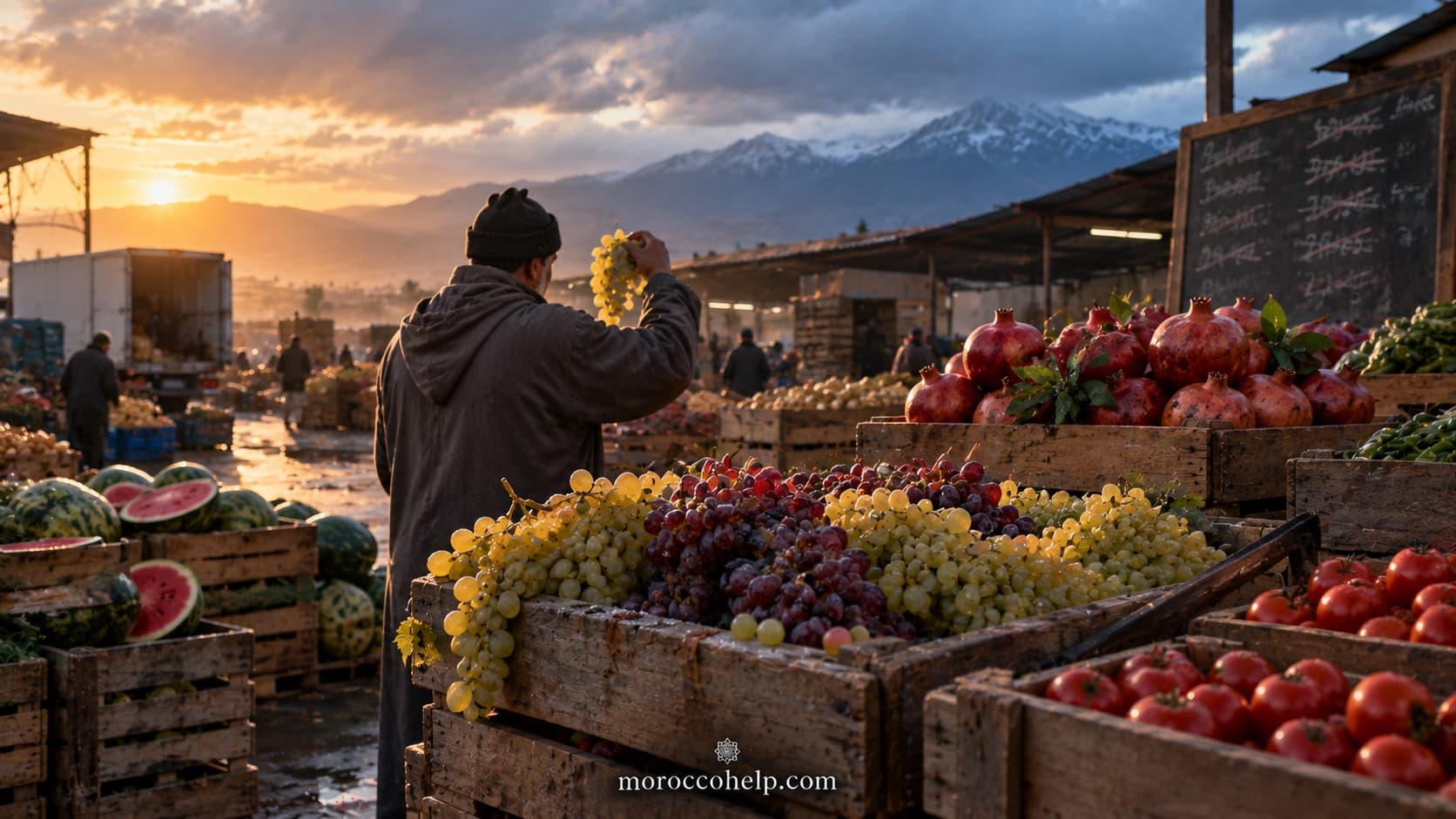
The weather flip Morocco is living through this week is not just a meteorological story: it is a balance-sheet event for anyone buying fresh produce at the wholesale market. A single week has produced the worst combination a grossiste can face: prices falling fast (every crate you hold loses value by the day), quality turning fragile (heat and storm stressed goods that spoil on the shelf), and a supply shock loading behind the market (storm damage in Souss-Massa that will push vegetable prices back up). This brief breaks the week down like an investment desk: what to sell down, what to pre-position in, where to park cash, and the arithmetic that should cap every lot you buy.
For the meteorological background (the 15 C cool-down, the Atlas storms and the record September heat that preceded them), see the detailed weather flip forecast on our meteo portal.
The verdict for the week
Risk-off week. Hold small inventories. Buy hand-picked lots only. Rotate cash fast. Pre-position, don't stockpile.
The week at a glance
Casablanca wholesale market, trader and bulletin data
Three forces define the week:
- Deflation now. Overproduction and full seasonal supply have crushed prices at the Casablanca wholesale market. Tomatoes collapsed in early September under the weight of production; watermelon bottomed at 0.50 DH/kg; grapes, the flagship case of the week, slid from roughly 11 DH/kg to 7 DH/kg in a matter of days, as traders report and as Meknes volumes flood the market.
- Fragility now. The record early-September heat (provincial records above 47 C) stressed vines and orchards; last week's storms and hail bruised fruit and opened the door to rot. Berries shatter, skins split, and cold chains sweat through the temperature swings.
- Inflation next. The storm that devastated Souss-Massa greenhouses (described by growers as historically rare) destroyed tomato, pepper and bean plantings. Wholesale market traders expect tomato, potato and pepper prices to rise in the coming days as damage and the seasonal production gap tighten supply.
The grape file: a -36% week
The clearest lesson of the week is the grape (l3nab) market. A lot bought at last week's ~11 DH/kg is worth ~7 DH/kg today: a 36% mark-to-market loss before spoilage is even counted.
Table grapes, wholesale price
Trader-reported, Casablanca market, September 2026
Why it happened: the Meknes table-grape harvest arrived in full volume exactly as demand softened after the summer heat, and quality concerns (heat-stressed berries, post-storm humidity favouring grey rot) pushed buyers to cherry-pick. When both price and quality fall together, inventory is a wasting asset.
Where prices stand: Casablanca wholesale snapshot
Indicative wholesale ranges (DH/kg, by quality and caliber, market bulletins of September 7-14):
Casablanca wholesale price ranges this week
Indicative, by quality and caliber, DH/kg
Two reads on this chart: storable roots (potato, onion, carrot) are calm, which makes them the safe havens of the week, while fruit is in open deflation (grapes shown at their new, lower range; watermelon in distress territory).
The risk matrix: every fragile line, one view
Produce risk matrix, week of September 14, 2026
Sell-down zone (falling price, fragile goods). Grapes, watermelon and figs. Every additional day of storage destroys both price and product. Strategy: clear remaining stock at market price, buy only hand-picked lots for a 24-48 hour rotation, and negotiate hard. In a falling market the buyer sets the terms.
Pre-position zone (rising price, solid goods). Tomato, pepper and green beans are cheap today but priced to rise as Souss-Massa damage works through supply. This is the one genuine buy of the week, with a strict condition: storm-bruised fruit is unmarketable, so inspect every lot and pay only for sound produce.
Park-capital zone (stable price, storable). Potato and onion. Boring is beautiful in a deflation week; they protect working capital and tolerate a few days of holding.
Deploy zone (season starting). Pomegranates and the first dates are arriving with firm demand and good shelf life. Cash freed from the sell-down zone logically rotates here.
The rest of the board: line-by-line notes
| Line | This week (DH/kg) | Read of the week |
|---|---|---|
| Tomato | 2.00 - 4.50 | Collapsed under full supply; storm-hit Souss plantings point to tightening ahead |
| Potato | 3.00 - 5.00 | Stable and storable: the capital-parking line |
| Onion | 2.50 - 4.00 | Quiet for now, but see the export file below |
| Carrot | 3.50 - 6.50 | Calm root line, wide by caliber |
| Courgette | 4.00 - 9.00 | Wide range by caliber; no storm signal reported |
| Grapes | 7.00 - 8.00 | Post-collapse range; hand-picked lots only |
| Watermelon | 0.50 - 1.50 | Distress pricing at the end of the season |
Two lines deserve extra attention beyond their price. Tomato is the asymmetric trade of the week: cheap on the spot market, expensive on the horizon. Wholesale bulletins of the past ten days show ranges as wide as 1.20 to 4.50 DH/kg depending on caliber and condition, which is exactly what a market in transition looks like: sound, exportable calibers hold the top of the range while bruised and small fruit clears at the bottom. Onion looks boring, and boring is the point, except that a policy file opened over the weekend that could change its calculus overnight.
Policy watch: the onion export file
On September 12, press reports indicated that Morocco is studying a ban on onion exports to African hinterland markets. The logic is familiar: when domestic supply tightens or prices rise, export restrictions push volumes back into the local market to protect households. The 2023 tomato file is the precedent. That year, after storm losses in the Souss, domestic tomato prices climbed to nearly 15 DH/kg before Morocco curbed exports, and the relief arrived only weeks later once redirected volumes reached the domestic market.
For a grossiste, an export ban is a double-edged event. If enacted, export-bound onion lots would land on the domestic market (a temporary cap on prices), while the export premium disappears for traders who supply African markets. The practical stance this week: keep onion in the park-capital zone, avoid building speculative stock on the expectation of either outcome, and watch for the official decree. Policy risk is not price risk, but it hits the same line on the balance sheet.
The export dimension: the storm meets the tomato machine
The Souss-Massa storm did not just damage a domestic crop. It hit Morocco's tomato export machine, a program that sends more than 92% of its volumes to the European Union and the United Kingdom. Growers describe greenhouse losses on a scale that is still being assessed, and growers describe an industry in post-storm turmoil.
The sequencing matters for the domestic market. Export programs prioritize premium calibers. When exportable fruit temporarily loses its channel, or when damaged plantings free up picking capacity, premium volumes can spill into the local market and deepen the current dip. Then the destroyed plantings bite: the autumn gap between the end of the open-field campaign and the ramp-up of the winter greenhouse campaign arrives with less supply behind it. In 2023, the same region saw output fall from roughly 975,000 tonnes to 695,000 tonnes after storm damage, and domestic prices only normalized after export curbs and replanting. Translation for this week: the cheap tomato window is real, but probably short.
The September season calendar
The seasonal backdrop is the silent driver behind every zone of the risk matrix:
| Status | Products | Trading implication |
|---|---|---|
| Arriving now | Pomegranates, early dates | Deploy zone: firm demand, good shelf life |
| Peak volumes | Grapes (final Meknes flush) | Supply glut: the price collapse underway |
| Late season | Prickly pear (hindienne) | Niche line, loyal demand, short window |
| Exiting | Watermelon, figs | Distress pricing; clearance economics only |
| Year-round stable | Potato, onion, carrot | Park capital while fruit deflates |
September is the hinge of the Moroccan produce year: the summer campaign empties the fields, storage is flushed before the heat returns next year, and everything that can be harvested is harvested at once. That is precisely why gluts and collapses cluster in this window.
The historical pattern: why autumn turns the market
Every year, the wholesale market follows the same hinge. Late August and September bring the summer glut: full fields, all storage emptied, and prices at their seasonal floor. Then the campaign ends: days shorten, northern supply falls off, open-field tomatoes give way to the greenhouse program that has not yet ramped, and October into November brings the price turn. The storm compresses that cycle this year. The glut phase is ending earlier and harder, and the tightening that would normally arrive with the October cold is already programmed into the destroyed Souss plantings. The grossiste who reads this calendar correctly treats this week's deflation not as an anomaly but as the discount window before the turn.
The spoilage arithmetic every buyer should run
In a fragile week, the number that decides profit is not the purchase price. It is the spoilage-adjusted cost of what actually sells. Buy at 3.50 DH/kg and lose 20% of the lot, and your effective cost per sellable kilo is 4.38 DH before you have earned a single dirham:
Effective cost per sellable kg vs spoilage rate
Lot bought at 3.50 DH/kg
Run the same arithmetic on a real lot. A 2-tonne grape purchase at 7 DH/kg ties up 14,000 DH. At 20% spoilage only 1,600 kg sell, so break-even sits at 8.75 DH/kg: above the top of the current 7-8 DH range, meaning the lot loses money even if every sellable kilo clears at the best price of the week. The same 14,000 DH in potato at 4 DH/kg with 2% loss breaks even at 4.08 DH/kg, inside a stable range. Same capital, opposite outcomes: the difference is entirely the spoilage line.
The rule of thumb for the week: every 10 points of spoilage add roughly 11% to your effective cost. A "cheap" fragile lot at 3 DH/kg with 25% spoilage costs more per sellable kilo (4.00 DH) than a sound storable lot at 3.80 DH with near-zero loss.
Position sizing for the week
Suggested allocation of the weekly buying budget. An allocation, not a guarantee; adjust to your turnover:
| Line | Share of budget | Rationale |
|---|---|---|
| Storable roots (potato, onion) | 30-40% | Capital preservation, price stability |
| Pre-positioned veg (tomato, etc.) | 20-30% | Cheap today, forward prices rising |
| Incoming season (pomegranate, dates) | 15-20% | Firm demand, good shelf life |
| Fragile fruit (grapes, figs) | max 10-15% | Hand-picked lots, 24-48h rotation only |
| Distress lines (watermelon) | opportunistic only | Clearance economics, zero storage |
The inspection checklist for fragile lots
- Grapes: intact powdery bloom, green flexible stems, shatter below 5% of berries, no vinegar smell at the crate bottom. Grey rot starts there.
- Watermelon: sound field spot, no soft shoulders; late-season heat hollows hearts, so open one crate per pallet.
- Figs: firm necks, no weeping eyes; storm-bruised figs collapse within hours.
- Tomatoes: reject storm-split shoulders and bruised shoulders; sound fruit only, even at a premium.
- Cold chain: ventilate crates before loading; condensation from the temperature swing is rot fuel. Transport in the cool of the evening.
Bottom line
Treat this week the way a trader treats a volatile market: sell down the wasting assets, pre-position the coming squeeze, park the rest. The grossiste who bought grapes at 11 DH/kg last week is financing that lesson. The one who runs the spoilage arithmetic before every purchase this week, reads the onion policy file, and respects the season calendar is being paid to learn it for free.
Follow the cool-down driving this market on our meteo portal: the September 14 weather flip forecast.
Marouan focuses on corporate taxation, VAT, and business compliance in Morocco. He writes practical guides that help entrepreneurs and companies navigate the Moroccan tax system with confidence.