In his Throne Speech of 29 July 2026, King Mohammed VI delivered what is arguably the most finance-focused royal address in recent memory. Growth figures, industrial sovereignty, SME access to credit, and the mobilisation of national savings all took centre stage. The message is unambiguous: finance is no longer a support function; it is the engine of the emerging Morocco.
This article breaks down every economic and financial announcement from the speech, explains what changes for businesses and households, and links to our detailed guides on the tax and regulatory reforms already underway.
4.9% growth and counting
The King confirmed that Morocco's GDP grew by approximately 4.9% in 2025, and that a similar or higher rate is expected for 2026. This outpaces most peer economies in the MENA region and is driven by a combination of good agricultural output, a record tourism season, and sustained industrial investment.
"The rate of growth was around 4.9% in 2025, and it is expected to reach an equivalent or higher level in 2026."
For businesses, this growth backdrop means continued consumer demand, infrastructure spending, and expansion opportunities, especially in the industrial and service sectors that the King specifically named: automobile, aeronautics, renewable energy, agri-food, and pharmaceuticals.
Finance: from intermediary to development partner
The most consequential section of the speech for our readers concerns the financial sector. The King called on banks, institutional investors, and capital markets to go beyond their traditional intermediation role and become active partners in national development. Specifically, he urged the sector to:
- Broaden access to financing (bank and non-bank) for small and medium-sized enterprises (SMEs), which remain the backbone of the Moroccan economy but historically struggle to secure credit.
- Fund innovation and industrialisation: the King wants the financial sector to back the ideas that become industries, from electric-vehicle batteries to green hydrogen megaprojects.
- Support export-oriented businesses: Moroccan companies expanding into African and global markets need trade finance, export insurance, and working-capital solutions that the current system does not always provide at scale.
- Mobilise national savings, especially institutional savings (pension funds, insurance reserves), and redirect dormant capital into productive investment rather than low-yield government bonds.
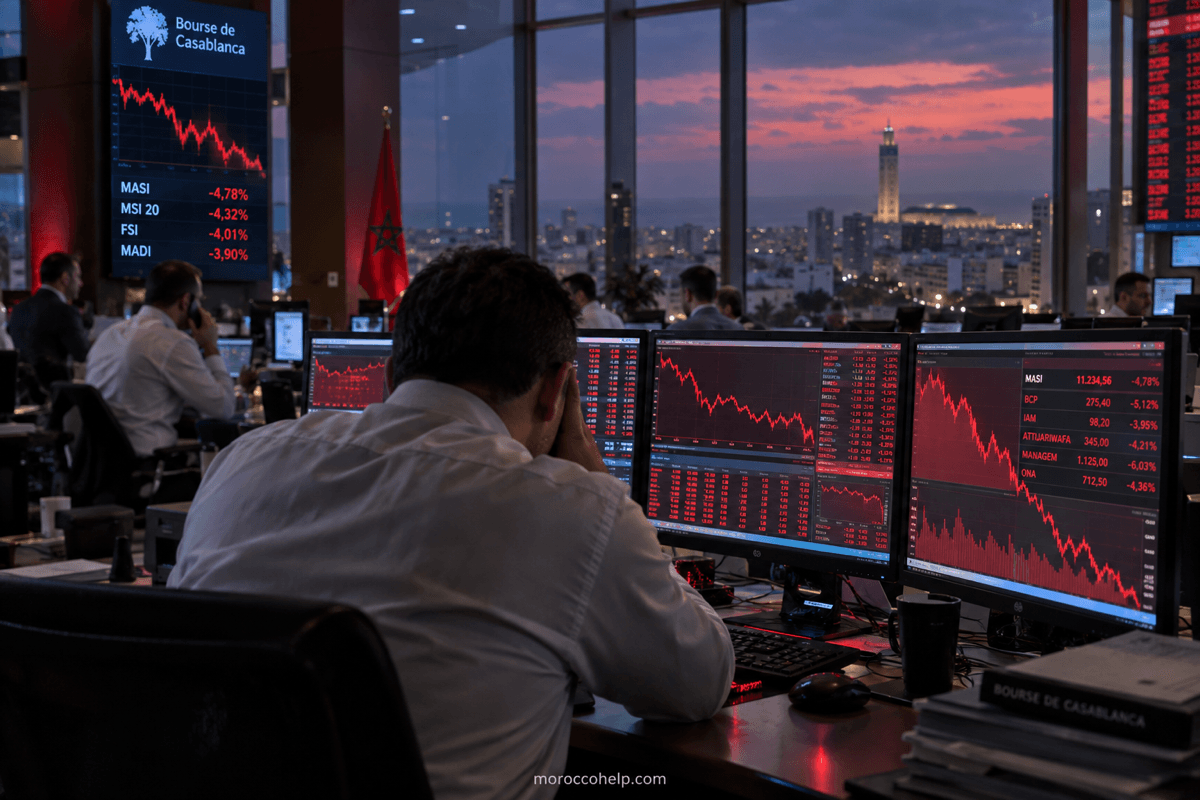
- Revitalise the Casablanca Stock Exchange, which has seen relatively few IPOs and limited liquidity in recent years. A deeper capital market would give growing companies an alternative to bank debt.
This agenda connects directly to the 2026 tax reforms already in motion. The expanded withholding tax (RAS) system, the two-rate corporate income tax scale (20% / 35%), and the convergence to two VAT rates all form part of a broader strategy to formalise the economy, broaden the tax base, and free up public revenue for productive investment.
Morocco: Africa's #1 automobile exporter
The King highlighted that Morocco has become the first exporter of automobiles in Africa, with an annual production capacity approaching one million vehicles. Together with aeronautics, the auto sector now represents over 40% of total Moroccan exports, surpassing phosphates for the first time.
New industrial milestones cited in the speech include:
- Aircraft engines and landing systems: Morocco has entered the elite circle of countries manufacturing these critical components.
- Electric-vehicle batteries: an integrated battery sector is under development, positioning Morocco in the global energy-transition supply chain.
- Green hydrogen: the "Morocco Green Hydrogen Offer" has moved from concept to implementation, with the first megaproject authorisations already awarded.
For finance professionals, these sectors represent the next wave of corporate lending, project finance, and supply-chain financing opportunities. The companies building these industries will need working capital, equipment finance, and eventually IPO underwriting.
Record tourism: 20 million visitors
The tourism sector achieved a historic performance in 2025, welcoming nearly 20 million visitors (including MRE, Moroccans Residing Abroad). This record underscores the sector's role as a major foreign-exchange earner and employment driver.
For the financial sector, tourism growth means opportunities in hotel financing, restaurant chains, travel-tech startups, and payment infrastructure. The King's call for broader financial inclusion aligns with the need to digitise payments across the tourism value chain.
Industrial sovereignty: 80% self-sufficiency
The agri-food and pharmaceutical industries now cover approximately 80% of national needs, a major step toward the industrial sovereignty the King has championed. A defence and cybersecurity industrial base is also being established, which will gradually generate development opportunities in a sector previously dominated by imports.
What this means for businesses and households
| Sector | What the speech means | Action for businesses |
|---|---|---|
| SMEs | Easier access to bank and non-bank financing | Prepare solid financials; explore capital-market options as exchanges deepen |
| Industry | Priority sectors: auto, aero, batteries, hydrogen, agri-food, pharma | Align investment plans with government-backed industrial zones and incentives |
| Exports | Financial sector called to support exporters | Leverage trade-finance instruments, explore OCO OCP / AMDIE support programmes |
| Tax | Continued formalisation and base broadening | Ensure compliance with RAS 2026, IS reform, VAT convergence |
| Savings/investment | Push to channel institutional savings into productive assets | Watch for new investment vehicles, fund structures, and market reforms |
| Households | Social-protection programmes and territorial development continue | Expect continued infrastructure investment in underserved regions |
The political transition
The King noted that these achievements transcend government and parliamentary mandates and expressed the hope that after the upcoming legislative elections and the formation of a new government, a new development cycle will begin. The key terms he used: "preserve achievements and continue large-scale projects and reforms".
For investors and businesses, this signals policy continuity: the reform trajectory (tax base broadening, financial-sector modernisation, industrial sovereignty) will continue regardless of the electoral outcome.
The road ahead
The 2026 Throne Speech paints a picture of a Morocco that is:
- Growing at nearly 5% with a diversified industrial base;
- Reforming its tax and financial systems to fund that growth domestically;
- Positioning itself as Africa's industrial and financial hub; and
- Calling on its financial sector to step up from intermediary to architect.
For Moroccan businesses, the message is clear: the next decade will reward companies that invest, formalise, and export. The tax and regulatory framework is being aligned to support that journey, and the financial sector is being asked to provide the fuel.
For the specific tax mechanics behind these reforms, see our RAS 2026 overview, our 10 worked examples, and our dividend withholding guide.
Sources
- Maghreb Arabe Presse (MAP) – mapnews.ma
- Medias24 – medias24.com
- Ministère de l'Économie et des Finances – finances.gov.ma
Disclaimer
This article analyses the public Throne Speech of 29 July 2026 as reported by the Moroccan press agency (MAP) and Medias24. It is for general information only and does not constitute financial, investment, or legal advice.
Marouan focuses on corporate taxation, VAT, and business compliance in Morocco. He writes practical guides that help entrepreneurs and companies navigate the Moroccan tax system with confidence.