Monday, September 21, 2026 was Morocco's first working day under its new legal time. On the night of Saturday the 19th to Sunday the 20th of September, at 2:00 AM, clocks were set back to 1:00 AM: the Kingdom moved back 60 minutes and permanently abandoned GMT+1, in force since October 2018. Gone too are the twice-yearly switches linked to Ramadan: the country is settling for good on Greenwich Mean Time, its natural solar time zone.
A seemingly trivial decision – one missing hour – that touches almost everything: the energy bill, the competitiveness of call centers, the Casablanca Stock Exchange sessions, banking hours, tourism and even children's sleep. Here is the 360-degree view.
The change in five numbers
Morocco's permanent return to GMT
The decision: what the decree says
The return to GMT was announced by government spokesperson Mustapha Baitas and formalized by decree: as of Sunday, September 20, 2026 at 2:00 AM, Morocco's legal time is GMT, with clocks set back 60 minutes. The text ends the regime introduced in October 2018, when Morocco adopted GMT+1 as its permanent time, with a temporary return to GMT during Ramadan.
In practice, Morocco is going back to its reference solar time, that of the Greenwich meridian. More precisely: the country will no longer change its clocks at all – not in spring, not in autumn, not for the holy month. That is the reform's main guarantee of stability.
Why now?
The time zone debate had long opposed two rationales. The first, economic: stay aligned with Europe, the Kingdom's leading trading partner, to keep cross-border trade and exported services flowing smoothly. The second, socio-biological: return to the natural solar time, reduce the gap between working life and the circadian rhythm, and simplify a double annual switch many experienced as a burden.
The government sided with the second. Two arguments prevailed: administrative simplification (a single, stable time zone, no switching) and the mixed energy record of GMT+1.
Energy: the 0.17% myth
Behind the 2018 switch to GMT+1 was a PwC study estimating that the new time zone would save Morocco about 0.17% of its energy consumption – mainly by cutting evening lighting, since the sun sets "later" on the clock.
Eight years on, the record is underwhelming:
- The measured energy impact remained minimal. Academic work on daylight saving reaches the same conclusion: lighting savings in the evening are largely offset by morning consumption, when it is still dark as people wake up.
- Demand patterns have changed. Moroccan electricity consumption is now driven by summer air conditioning and industrial uses, far more than by lighting. Yet an earlier solar hour means an earlier sunset: in summer, lighting and cooling overlap earlier in the evening.
- The stability argument won. With a fixed time zone, no more seasonal system reconfiguration, no artificially shifted consumption peaks twice a year.
Economists' verdict: the energy stakes of the time zone were mostly symbolic. For a country massively deploying solar and wind power, 0.17% of lighting consumption sits within the margin of error.
Offshoring and BPO: the sore point
This is the reform's sensitive spot. GMT+1 supporters repeated it: Morocco must stay aligned with Europe, where its clients live. The BPO sector (Business Process Outsourcing) – call centers, IT support, back-office – employs close to 100,000 people in customer relations alone, and more counting IT and back-office, serving French, Spanish, Belgian and British companies.
With the return to GMT, the map of time gaps is redrawn:
| When it is 12:00 in Casablanca | Summer (April - October) | Winter (November - March) |
|---|---|---|
| Paris, Madrid, Brussels | 2:00 PM | 1:00 PM |
| London, Lisbon | 1:00 PM | 12:00 PM |
| Dubai | 4:00 PM | 4:00 PM |
| New York | 8:00 AM | 7:00 AM |
On Monday, September 21, Moroccan teams discovered a two-hour gap with France and Spain, still on European summer time until October 25. In practice:
- A call center guaranteeing 9 AM - 6 PM coverage for French clients must now operate from 7 AM to 4 PM, Casablanca time. Early shifts start before sunrise for part of the year, with the usual consequences: transport, safety, morning-shift bonuses.
- Synchronous meetings with European headquarters concentrate into a narrower afternoon window, while Moroccan workdays end before the European day does.
- Conversely, alignment with the UK, Ireland and Portugal improves sharply: a single hour of difference in summer, the same hour in winter. For outsourcers targeting the fast-growing English-speaking market, GMT is an asset.
- From October 25, 2026, Europe switches to winter time and the gap with Paris and Madrid falls back to one hour, until the following spring.
The real cost for offshoring is therefore not the gap itself – Morocco remains within a 1-to-2-hour neighborhood, unbeatable against Asia or Southern Africa – but the management of a gap that varies with the European season, which complicates schedules and service level agreements. Major operators have already started revising their service windows and shift premiums.
Finance: stock exchange, banks and deadlines
For finance professionals, the time zone is a daily operational variable.
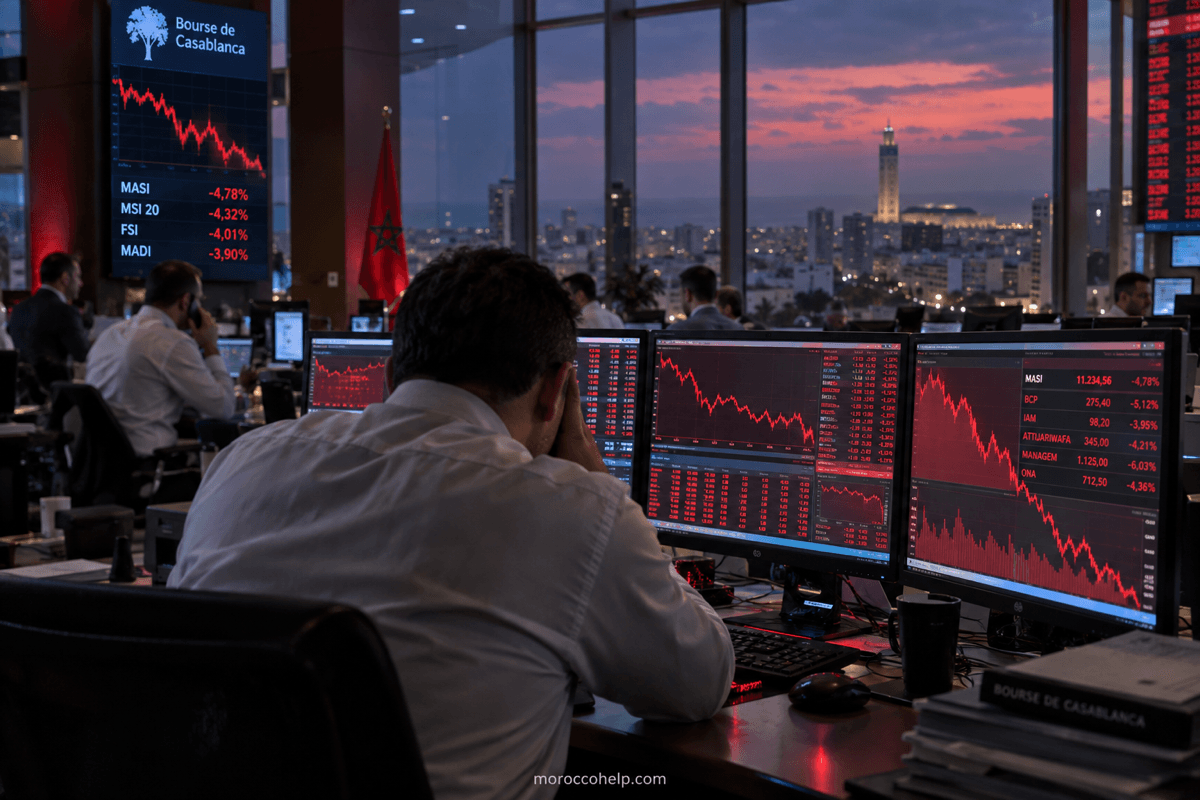
- Casablanca Stock Exchange. Sessions (9:30 AM - 3:30 PM, Casablanca time) now run 11:30 AM to 5:30 PM Paris time in summer: the Moroccan close exactly coincides with Euronext's. In winter, the exchange opens at 10:30 AM Paris time and closes at 4:30 PM, one hour before Euronext.
- Banks and payments. Cut-off times for international transfers (SWIFT, SECA via European correspondents) are set in headquarters time: treasury and cash management gain an hour of leeway in the morning and lose one in the evening.
- Tax and filings. DGI, CNSS and tax-return deadlines remain in Moroccan local time: no substantive change, but multi-site groups must resynchronize internal calendars.
- Energy markets. Electricity peak profiles are now read in GMT, changing how large industrial consumers interpret load curves.
Tourism: a real constraint?
For the tourism sector, the return to GMT "can open new room for maneuver rather than create a constraint," summed up Dr. Fadwa, an expert in tourism economics. The overall reading:
- Flights and transfers align with an earlier solar schedule: earlier sunsets, dinners and evening entertainment shifted toward hours closer to those of European tourists, who themselves live one (or two) hours later.
- Morning excursions benefit from earlier light – a selling point for nature, golf and kitesurf tourism.
- The brochures' "minimal jet lag" promise remains intact: 1 to 2 hours with Europe, none with the UK in winter.
Daily life and health: the end of micro-shifts
The one-hour setback on September 20 was well received by most people: you "gain" an hour of sleep, and legal time moves closer to solar time. Chronobiologists welcome the alignment with the natural circadian rhythm: more morning light at wake-up, melatonin better synchronized at bedtime.
Above all, the disappearance of repeated clock changes eliminates the hidden costs documented worldwide: sleep disorders in children, accident spikes in the week after the switch, IT scheduling errors. For HR departments, a single instruction was needed: manage the night of September 19-20 in continuous-run factories and services (time tracking, night hours, payroll).
Checklist for companies
- Audit your schedules and SLAs: make sure the service windows promised to European clients remain workable in GMT, in both summer and winter.
- Update your systems:
Africa/Casablancatime zone in the tz database (already updated), PBX clocks, CRM, scheduling tools, on-premise servers. - Realign overnight jobs: backups, batch processing and maintenance windows must be resynchronized with European headquarters' reference times.
- Review BPO contracts: morning and evening premiums, staff shuttles, team working-hour spans.
- Communicate: update email signatures, storefront websites and displayed opening hours (banking, support, sales).
- Check September payroll: the night of September 19-20 lasted 25 hours for continuous-run teams – verify how hours for that particular night were recorded.
Frequently asked questions
Why did Morocco return to GMT?
The government decided to abandon GMT+1 (in force since 2018) to simplify the time system – no more clock changes, including during Ramadan – and return to the country's natural solar time. GMT+1's energy record (0.17% of claimed savings in the PwC study) was never significant.
What is the time difference between Morocco and France?
Morocco is now on GMT. With France and Spain, the gap is 2 hours during European summer time (late March to late October) and 1 hour in winter. With the UK and Portugal: 1 hour in summer, none in winter.
When did the time change take place in Morocco?
On the night of Saturday September 19 to Sunday September 20, 2026: at 2:00 AM, clocks were set back to 1:00 AM. It was the last clock change in the country's recent history, as the GMT time zone is now permanent.
Will the return to GMT raise electricity bills?
The impact is marginal either way. The lighting savings achieved under GMT+1 were estimated at 0.17% of consumption; the shift in evening peaks caused by GMT is of the same order of magnitude. The country's real energy levers lie elsewhere: solar, wind, industrial efficiency.
What should offshoring companies do?
Revise schedules of teams synchronized with Europe (a 7 AM start for
a 9 AM French service window in summer), adjust shift premiums,
resynchronize batch jobs and SLAs, and update all IT systems to the
updated Africa/Casablanca time zone.
Will Morocco still change its clocks for Ramadan?
No. The return to GMT is definitive: the exceptional mechanism that set clocks back during Ramadan and moved them forward afterwards disappears. The GMT time zone applies year-round, Ramadan included.
Finance Morocco Help
Editorial Team
The Finance Morocco Help editorial team produces free, practical financial guides for Morocco.