Tuesday, September 29, 2026. A heavy week opens for the Moroccan economy: Bank Al-Maghrib has just released its latest macroeconomic projections, half-year earnings keep rolling in on the Casablanca Stock Exchange, and international markets remain dominated by expensive oil and elevated US rates. This brief walks through, in numbers, what actually matters for Moroccan savers and business owners.
The week in five numbers
Morocco and international markets, September 29, 2026
Bank Al-Maghrib holds its key rate at 2.25%
At its third quarterly Council meeting of the year, on Tuesday, September 22, 2026, Bank Al-Maghrib decided to keep its key rate at 2.25%, extending the monetary stability that followed the 2025 easing cycle. The decision rests on remarkably contained inflation: the central bank projects 0.7% in 2026, before a normalization to 1.5% in 2027 — levels comfortably within its target.
The growth path, however, was revised down: after 4.9% in 2025, GDP is expected to expand 4.4% in 2026, then slow markedly to 2.9% in 2027, weighed down by a weaker agricultural campaign and an uncertain external environment. Official reserve assets are projected to reach 502.8 billion dirhams by end-2026 and 515.3 billion in 2027 — roughly 5.5 months of imports, a comfortable cushion for the dirham's peg.
In practice. A stable 2.25% key rate means the cost of credit stays low for households and companies: mortgage and business-loan rates should not move before year-end. Good news for borrowers, less so for savers, whose deposits remain thinly remunerated.
What international institutions see
The international consensus remains more upbeat than the central bank. The EBRD (European Bank for Reconstruction and Development) projects 4.8% growth for Morocco in 2026, moderating to 3.9% in 2027, crediting the economy's resilience despite regional tensions. The IMF, on its latest mission, likewise noted momentum above its earlier expectations.
On the fiscal side, the signal is positive: the budget deficit kept narrowing over the first eight months of 2026, supported by solid tax revenues — a trajectory that underpins the Kingdom's credibility on sovereign debt markets, weeks before the 2027 finance bill is tabled.
International markets: oil and US rates set the tone
The global backdrop remains demanding for an energy importer like Morocco:
- Expensive oil. Brent crude for November delivery trades around $95 a barrel, a level sustained by Middle East geopolitical tensions that marked 2026 (including the Strait of Hormuz closure episodes in the first half). Every $95 barrel thickens the national energy bill and weighs on the trade balance's fuel line.
- US yields stay high. The 10-year US Treasury yield hovers around 4.7%, and is higher still at the 30-year point. This keeps pulling capital into US bonds and complicates funding for emerging economies.
- A nervous September on Wall Street. Historically Wall Street's cursed month, September 2026 lived up to its reputation: after a string of losing sessions, markets rebounded sharply on September 11, but volatility persists as investors balance oil-driven inflation fears against hopes of Fed easing.
- The US–China trade truce. Extended to January 2027, the tariff truce keeps global trade broadly calm — a positive for world commerce, and therefore for Moroccan exports (automotive, textile, phosphates).
What this global backdrop means for Morocco
Morocco is navigating this environment on relatively solid fundamentals:
| International factor | Expected impact on Morocco |
|---|---|
| Brent ≈ $95/bbl | Heavier energy bill, but inflation contained by administered prices (butane gas, sugar) |
| US yields ≈ 4.7% | Pressure on emerging-market flows, cushioned by dirham stability and reserves |
| EU partner growth | A relay for exports, tourism and MRE remittances |
| US–China truce | Stability for supply chains and foreign investment |
Moroccan inflation at 0.7% — among the region's lowest — is the main shock absorber: administered prices and the dirham's stability, anchored to a euro-dollar basket, protect purchasing power better than in most neighboring countries. The flip side is a wider trade deficit driven by the oil bill, partly offset by tourism receipts, remittances from Moroccans abroad and fertilizer exports.
What to watch this week
- Global market reactions to US macro releases, which will steer expectations for the Fed's next decision.
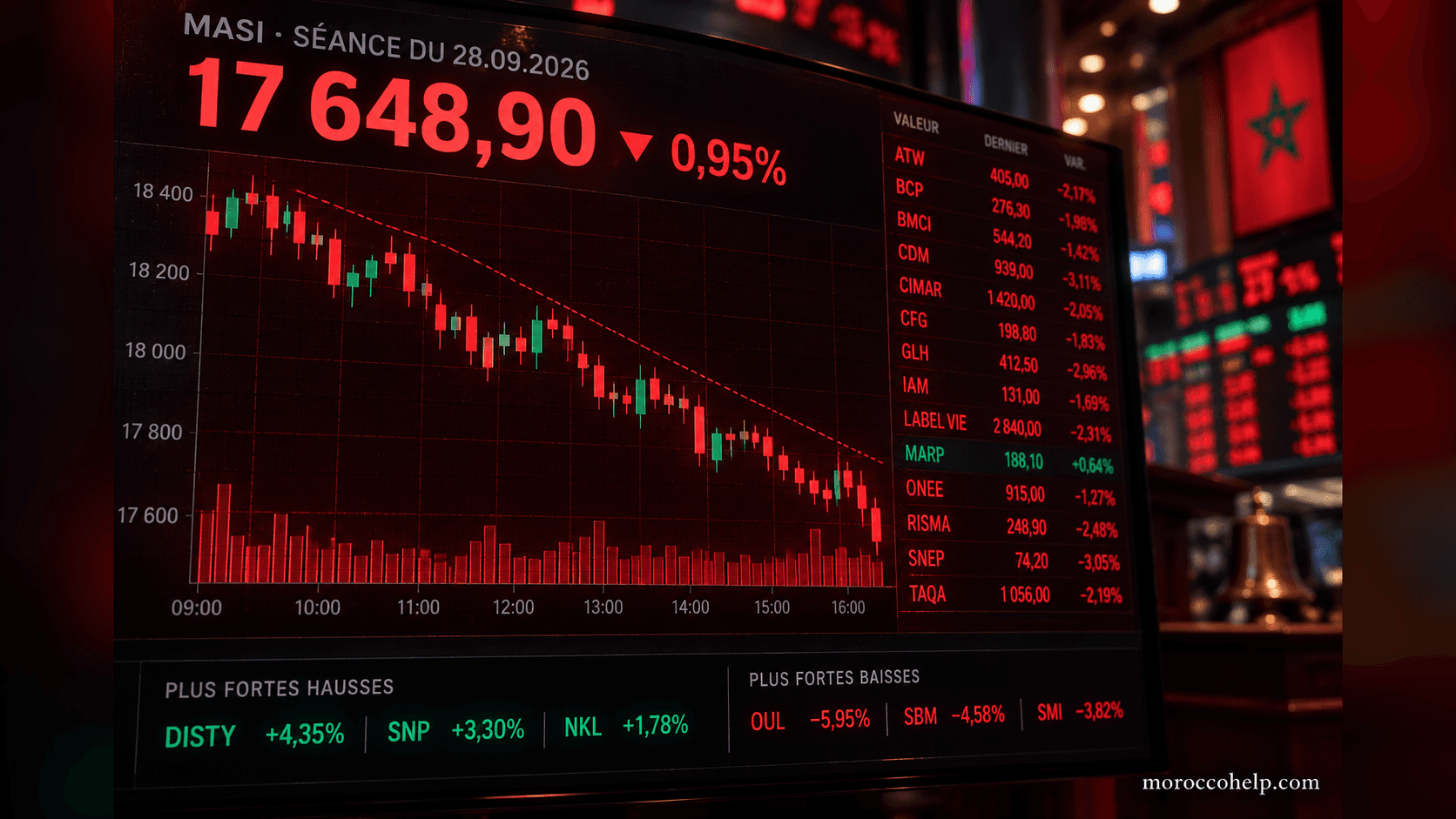
- Half-year earnings on the Casablanca Stock Exchange — broadly positive so far, yet they have not turned the MASI around (see our coverage of Monday's September 28 close).
- The first outlines of the 2027 finance bill, whose choices on taxation and public investment will be closely watched by businesses.
The bottom line
Bank Al-Maghrib is playing for time: with near-zero inflation, the priority is not tightening but accompanying a slowing economy. The real year-end challenge lies abroad — oil prices and US rates — and, at home, in the 2027 budget's ability to support investment without widening the deficit.
Main sources: Bank Al-Maghrib policy decisions, Morocco World News, FNH and Maroc Hebdo for BAM forecasts, Boursenews for market coverage.
Yassine follows the Casablanca Stock Exchange, Bank Al-Maghrib decisions and Morocco's macroeconomic indicators. He translates market moves into clear, practical takeaways for Moroccan investors and savers.