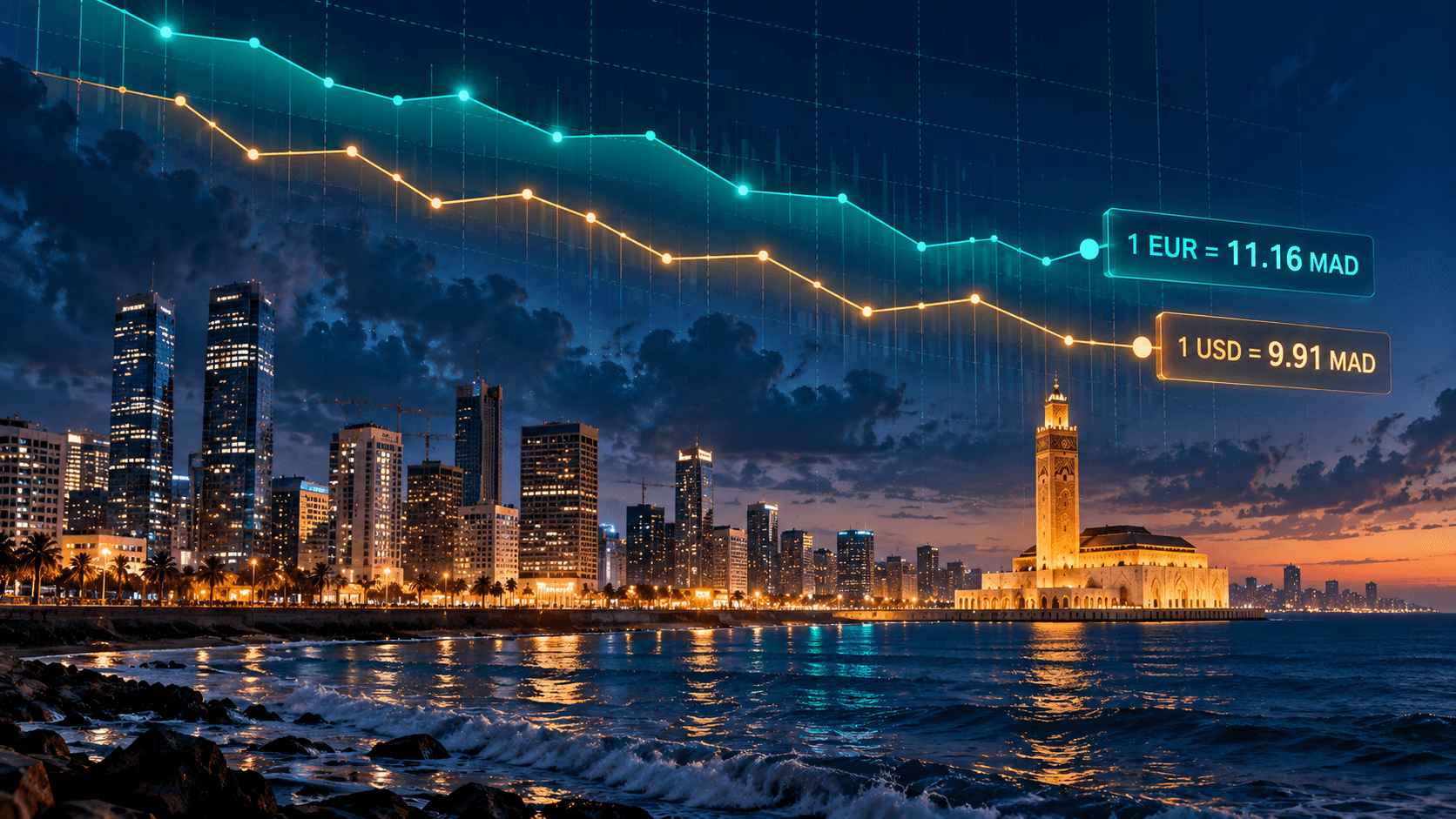
Monday, October 5, 2026. The first trading session of the week confirms what the weekend charts hinted at: the Moroccan dirham is sitting at its weakest levels in several weeks against both currencies of its reference basket. One euro now buys 11.16 dirhams, one US dollar 9.91 dirhams, and Bank Al-Maghrib's Monday fixing printed just 0.101 dollar per dirham. After Friday's sharp session and a ten-session losing streak against the dollar, here is what the move means in numbers, and for your wallet.
The dirham this Monday, in five numbers
Mid-market rates and Bank Al-Maghrib fixing, October 5, 2026
Where the dirham stands after ten sessions of slide
The slide did not happen overnight. Since late September the dirham has lost ground almost daily against the dollar, from 9.62 MAD per dollar on September 28 to 9.91 today, about -2.9% in a week and -5.6% over the past month (the dollar went from roughly 9.35 dirhams in early September to 9.91). Over twelve months, the dirham is down close to 8% against the dollar and about 4.5% against the euro.
Against the European currency, the damage is more recent but sharp: the euro jumped from 10.99 MAD on September 28 to **11.09 in Friday's violent session, then to almost 11.21 on Saturday before settling at 11.16 today.
What 1 euro buys in dirhams
Daily mid-market rate, September 26 – October 5, 2026
What 1 US dollar buys in dirhams
Daily mid-market rate, September 26 – October 5, 2026
Why the dirham keeps sliding
Three forces are pushing in the same direction:
- A strong dollar. With the US 10-year Treasury yield still around 4.7%, global capital keeps flowing into dollar assets. Every strong-dollar wave hits the dirham mechanically, since the dollar weighs 40% in the currency basket to which the MAD is anchored.
- A wide rate differential. While the Fed holds a higher-for-longer line, Bank Al-Maghrib kept its key rate at 2.25% on September 22 (our coverage here) , the right call for a domestic inflation of 0.7%, but a call that widens the interest-rate gap and nudges the dirham toward the weak side of its band.
- An expensive energy bill. Brent near $95 a barrel inflates the dollar-denominated import bill, raising demand for foreign currency just as the dirham weakens, a self-reinforcing loop the central bank watches closely.
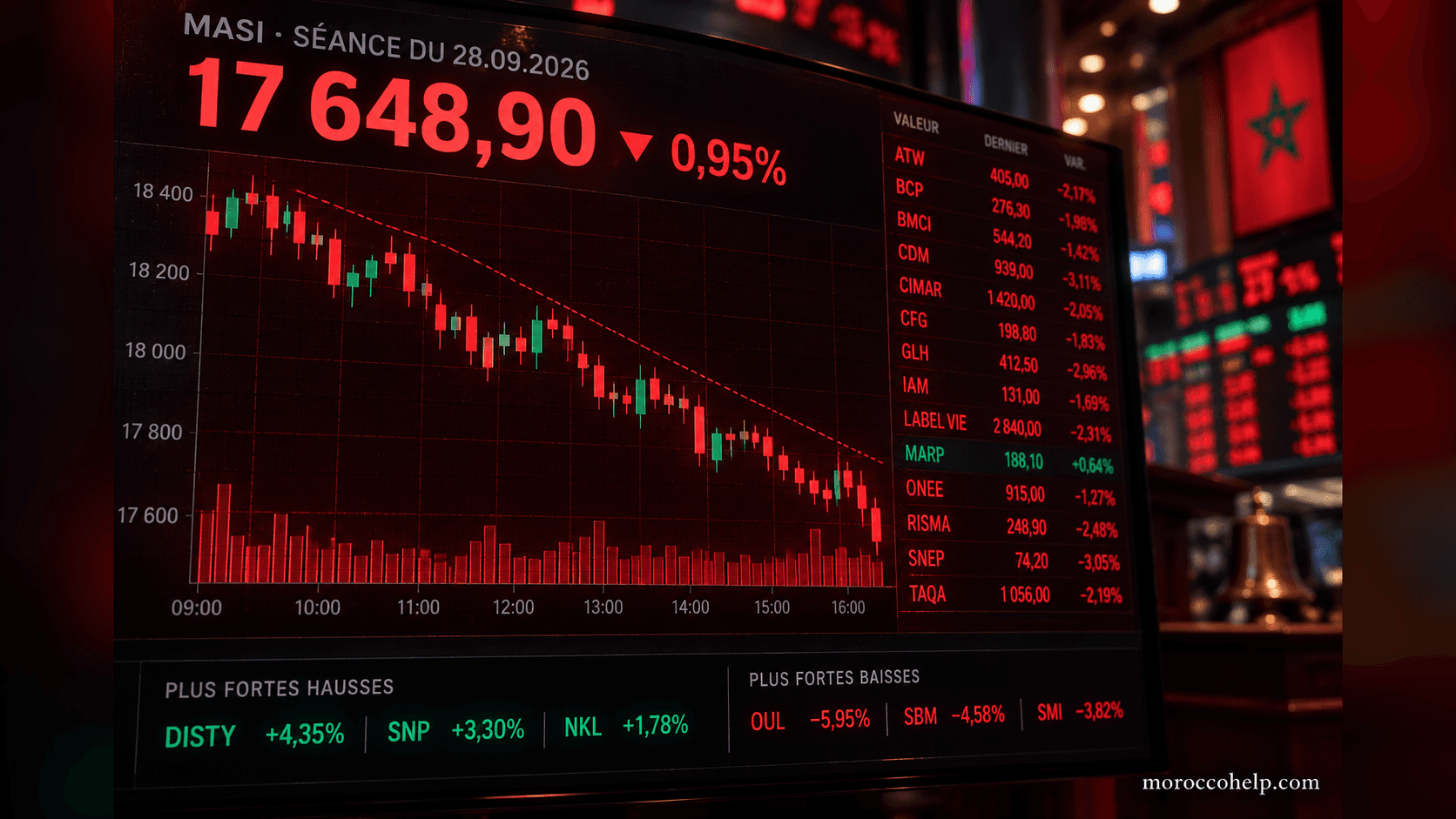
The Casablanca equity market's difficult September, the MASI's worst week of the month (see our brief) , added foreign-outflow pressure on the local currency.
A managed slide, not a run on the currency
Context matters: the dirham does not float freely. It tracks a euro-dollar basket (60% euro / 40% dollar), with Bank Al-Maghrib setting a daily fixing and letting the currency drift within a ±3% fluctuation band around its central rate, a framework widened in March 2020. What the past ten sessions show is the dirham being allowed to use the weak side of that corridor, not breaking away.
The cushion is solid: official reserves are projected at 502.8 billion dirhams by end-2026, roughly 5.5 months of imports (BAM's outlook). A weaker dirham at these levels is a policy-tolerated adjustment, not a credibility problem.
What a weaker dirham means for you
| Channel | Effect of the dirham at 11.16 per euro / 9.91 per dollar |
|---|---|
| Importers (equipment, wheat, inputs) | Invoices rise in dirhams; the dollar-priced energy bill compounds with $95 Brent |
| Exporters (automotive, phosphates, textiles) | More competitive abroad; dirham revenues on foreign sales increase |
| MRE remittances (mostly in euros) | Each euro converts into more dirhams for the family |
| Tourism | Euro-area visitors get more dirhams per euro, Morocco becomes cheaper |
| Savers | Import price pass-through is a risk, but inflation is contained at 0.7% (BAM) and administered prices (butane, sugar) buffer the shock |
In practice. €1,000 sent or converted today brings 11,158 dirhams, versus about 10,990 a week ago (+168 MAD) and roughly 10,760 in early September. On the dollar side, $1,000 now costs 9,913 dirhams versus 9,615 last Monday (+298 MAD), a real squeeze for businesses billing imports in dollars.
What to watch from here
- Bank Al-Maghrib's daily fixings, the pace at which the central bank lets the dirham drift within its band says a lot about its FX strategy for the closing quarter.
- US macro releases and Fed expectations, the primary driver of the dollar leg; any easing of the 4.7% yield environment would relieve pressure.
- The 2027 finance bill, its trade and investment measures will frame the external accounts that ultimately anchor the currency (what to expect).
The bottom line
The dirham's slide is real but orderly: multi-week lows against both the euro (11.16) and the dollar (9.91), after a week where it lost about 2.9% and 1.6% against them respectively. For exporters, MRE families and tourism, the weaker MAD is a tailwind; for dollar-paying importers, it is a margin squeeze arriving on top of $95 oil. With inflation near zero and reserves at five and a half months of imports, Bank Al-Maghrib can afford to let the band work. The number to watch now is whether the Fed finally blinks.
Yassine follows the Casablanca Stock Exchange, Bank Al-Maghrib decisions and Morocco's macroeconomic indicators. He translates market moves into clear, practical takeaways for Moroccan investors and savers.