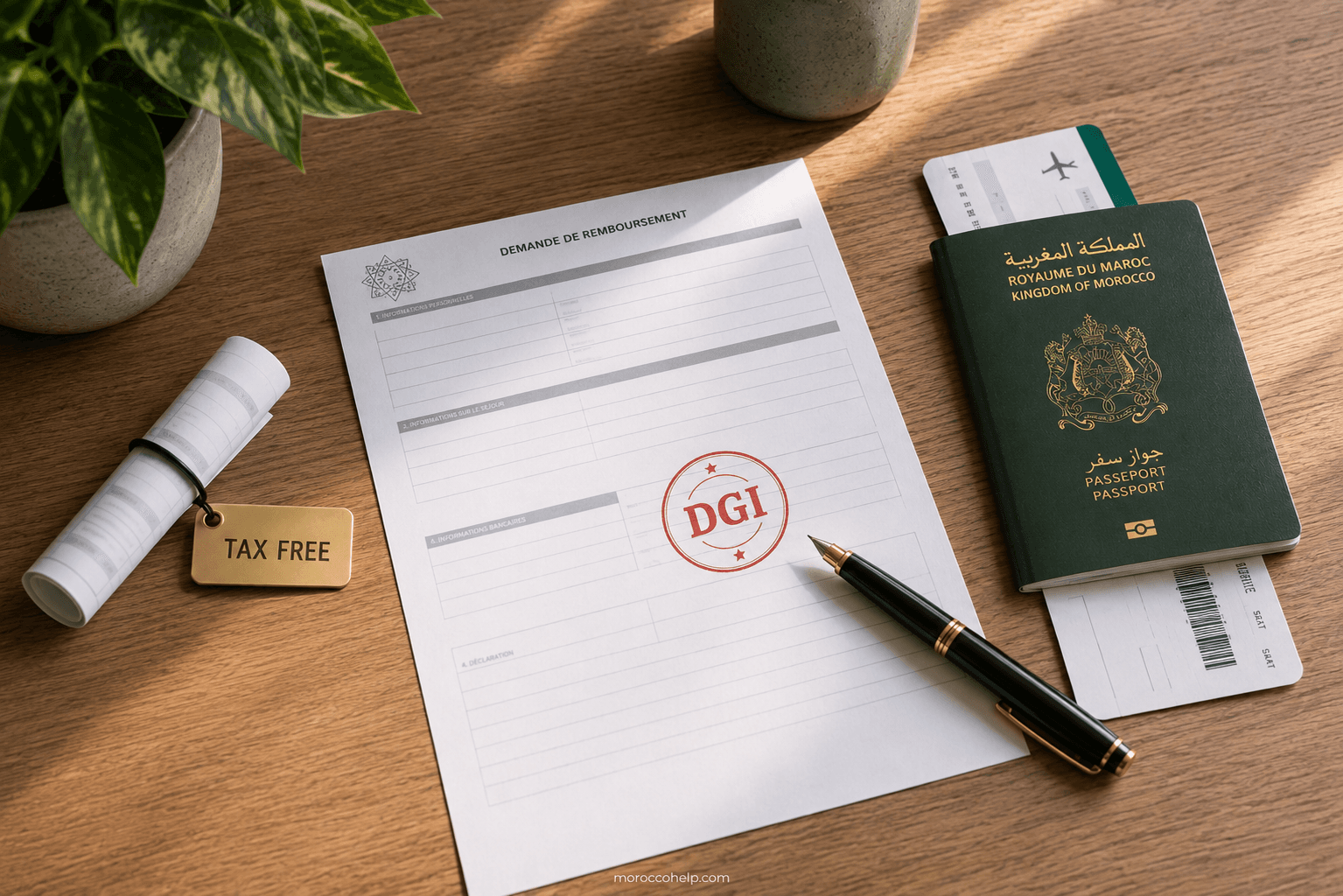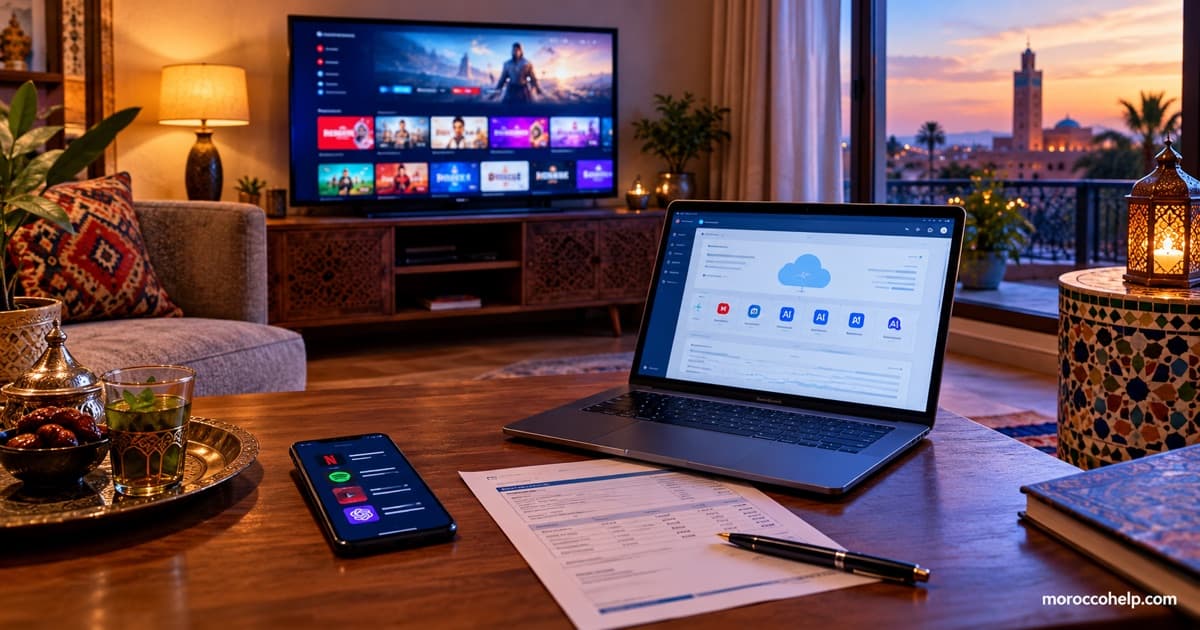
Has your Netflix bill gone up in recent months? Your ChatGPT Plus subscription, your AWS server or your Spotify plan too? It is not (necessarily) a price increase by the platforms: it is Moroccan VAT at 20% now applied to digital services sold by foreign companies. Since 11 June 2026, suppliers with no establishment in Morocco must register for VAT with the Direction Generale des Impots (DGI), and by late September around thirty platforms (Netflix, Spotify, Google, Apple, TikTok, OpenAI and Amazon) were effectively collecting the tax from their Moroccan customers. Here is a quiet but very concrete reform, in the footsteps of the 2026 two-rate VAT reform, with, at the end, the right reflexes depending on your status: individual, auto-entrepreneur or company.
Where the reform comes from: the full timeline
The scheme has a longer history than most people think:
- 2024 Finance Act: the principle is set: remotely supplied, dematerialised services from foreign providers enter the scope of Moroccan VAT.
- Decree no. 2-25-862 (Official Bulletin, December 2025): the implementing rules are fixed.
- 11 June 2026: the DGI makes its "Taxation on digital services" e-service operational (accessible via SIMPL), where foreign suppliers can register, obtain a tax identification number, declare their Moroccan revenue and pay the VAT.
In practice, registered platforms must: declare every quarter the revenue made in Morocco (before the end of the first month of the following quarter), pay the corresponding VAT with no right to deduction, and keep a detailed register of services for ten years, available to the administration on request.
How Morocco knows a customer is… in Morocco
That is the key of the scheme: locating the consumer. The decree relies on several criteria:
- a bank card issued by a Moroccan institution;
- a billing address in Morocco;
- an IP address located in the Kingdom;
- a Moroccan phone number.
In other words: as soon as you pay your subscription with a Moroccan card, the platform must treat you as a Moroccan customer and bill VAT.
Who is already billing: a growing list
By late September 2026, according to business press, around thirty platforms applied the 20%. The map of affected families:
| Service family | Confirmed or typical examples | Price effect |
|---|---|---|
| Video and music streaming | Netflix, Spotify, Apple TV+ | +20% passed on the subscription |
| AI subscriptions | ChatGPT (OpenAI, VAT collected since 1 August), paid assistants | +20% (e.g. a $20 plan → about $24) |
| Consumer cloud and hosting | Amazon, paid storage plans, web hosting | +20% on B2C uses |
| App stores | Google, Apple (in-app purchases) | +20% on content and paid apps |
| Social networks | Meta (Facebook, Instagram), TikTok | +20% on paid services (subscriptions, coins…) |
| Mobility and travel | Uber, Airbnb | Within the scheme's scope depending on the service |
| Online software | office suites, design tools, videoconferencing | +20% on non-registered accounts |
In short: a subscription billed at 100 dirhams excluding tax now costs 120 dirhams including tax. For a stack of foreign subscriptions worth 500 MAD per month, that is 100 MAD of VAT every month.
Important nuance: the law does not oblige platforms to pass the VAT on to their prices: it is each company's commercial choice. In practice, most giants passed it on, but check the "VAT" or "tax" line on your bills: some platforms absorbed it.
What to do depending on your status: individual, auto-entrepreneur, company
That is THE question raised by the reform. The answer depends entirely on your tax status.
You are an individual (natural person)
VAT is a final cost: there is no recovery mechanism for individuals. The only levers are commercial:
- Check the VAT line on your bills: if your favourite platform absorbed it, nothing changes for you.
- Compare plans: annual plans (often discounted), family bundles, ad-supported tiers.
- Consolidate: one family plan at 160 MAD all-in beats two individual subscriptions at 100 MAD + VAT.
You are an auto-entrepreneur
This is the trickiest case. The auto-entrepreneur regime (see our article on the auto-entrepreneur and the CPU in Morocco) places you outside the scope of VAT: you do not charge VAT to your clients… and you cannot deduct the VAT you pay. VAT on your digital tools (ChatGPT, Canva, cloud storage, hosting) is therefore a real cost, to be built into your rates. Two possible strategies:
- Stay under the auto-entrepreneur regime and pass the extra cost into your prices, the simplest option as long as your digital spending stays modest.
- Switch to the common regime (simplified net income) beyond a certain spending volume: you become VAT-registered, you recover VAT on purchases… but you must also charge VAT to your clients and keep a VAT accounting. The switch pays off when the recoverable VAT exceeds the administrative cost; run the numbers with your accountant.
In all cases: keep every VAT invoice.
You are a VAT-registered company (SARL, SAS…)
Good news: for registered customers, the regime was already settled by the reverse-charge (autoliquidation) mechanism: the Moroccan company declares the VAT due by the foreign supplier and recovers it at the same time, with a neutral effect. For subscriptions billed with Moroccan VAT (converted "consumer" accounts), the VAT becomes deductible like any input VAT. The right reflexes:
- Fill in your tax identification (IF) and ICE numbers on your AWS, Google Workspace, OpenAI and other provider accounts, to get properly issued invoices;
- If you still pay some services on a "personal" account, switch to business offers: clean invoicing, clean deduction;
- Watch the withholding side: payments for services abroad remain subject to the RAS/VAT regime, with its 5,000 and 50,000 MAD exemption thresholds detailed in our article on the RAS VAT 5000/50000 threshold in Morocco.
Why Morocco did this (and why now)
Three reasons combine:
- Competitive fairness. Moroccan digital players had to bill VAT while foreign giants did not: a structural 20% disadvantage, now corrected.
- Tax revenue. Millions of streaming, cloud and AI subscriptions escaped any local taxation; collecting on them is a significant source of revenue, with no new tax to create.
- A global movement. Morocco joins an international wave of VAT registration for foreign digital platforms, accelerated in 2026 across many countries.
One challenge remains, experts acknowledge: identifying suppliers that do not register. Payments by Moroccan bank card could serve as a trace. The scheme is young, and its enforcement capacity will be judged in the coming quarters.
FAQ
Since when does VAT apply to foreign digital services in Morocco?
The principle comes from the 2024 Finance Act, the rules from decree no. 2-25-862 (December 2025), and the DGI e-service has been operational since 11 June 2026. By late September, around thirty platforms were already collecting; OpenAI, for instance, has collected since 1 August.
Did Netflix subscriptions really go up?
The price excluding tax did not change: it is the 20% VAT added by the platforms that chose to pass it on. The line shows clearly on the bill. If a platform you use does not bill VAT yet, the increase will come when it registers.
I am an auto-entrepreneur: can I recover this VAT?
No: the auto-entrepreneur regime is outside the scope of VAT, so the tax on your foreign subscriptions is a final cost. Two options: build it into your prices, or switch to the common regime (simplified net income) to become VAT-registered and deduct VAT when your digital spending justifies it.
AWS now bills VAT to my startup: what should I do?
Check that your IF and ICE numbers are filled in on your AWS account (and your other cloud providers): as a registered company, VAT is deductible or handled by reverse charge, provided the invoicing is properly issued.
How does Morocco know I am a Moroccan customer?
Several criteria set by the decree: Moroccan bank card, billing address in Morocco, IP address located in the Kingdom, or Moroccan phone number.
Are Uber and Airbnb affected?
These services fall within the scope of the scheme for dematerialised services supplied to non-registered customers in Morocco; the concrete effect depends on how each platform structures its local invoicing.
Read more
- Morocco VAT reform 2026: two rates only
- How VAT works in Morocco
- Auto-entrepreneur and the CPU in Morocco 2026
- VAT withholding: the 5,000 / 50,000 MAD exemption threshold
Marouan focuses on corporate taxation, VAT, and business compliance in Morocco. He writes practical guides that help entrepreneurs and companies navigate the Moroccan tax system with confidence.